Angel City Press was established in 1992 and is
dedicated to the publication of high-quality nonfiction
books. The award-winning books from Angel City Press are
sold in fine gift and book stores, and on the Web.
Drenched
in nostalgia yet undeniably cool, each Angel City Press
book is luxuriously illustrated and showcases the modern
design concepts of California's top graphic artists.
So it
is with the entire treasury of Angel City Press books --
each is forever readable, forever giftable. Angel City
Press books are published with extraordinary attention to
detail, in the finest tradition of the bound page.
By May
of 1993 we had our first book, Hollywood
du Jour, in the hands of hungry,
nostalgic readers... but not for long; they were quite
busy whipping up Sticky Orange Rolls from the Tick
Tock Tea Room and swilling Moscow Mules from Cock 'n'
Bull.
In the ensuing two
decades, we have learned that our readers' tastes and
hungers go way beyond food, and have done our best to
chronicle the cultural history of the West.
Angel
City Press is located by the sea in Santa Monica,
California
|
|
|
Who's talking / signing
where? See the Angel City Press Event
Calendar
Join our Mailing List
|
| Have you ever
heard of the architect who
designed City Hall, the Coliseum,
Bullock's Wilshire, Union Station... ?
|
|
Architect John Parkinson
died in 1935, and the Los Angeles
Times praised him: “Future
generations have only to walk
through the streets of Los Angeles
to be reminded how much John
Parkinson in his lifetime
contributed to the city that grew
up under his hand.” In Iconic
Vision: John Parkinson,
Architect of Los Angeles,
author Stephen Gee proves that
this singular visionary created
the look of America’s most dynamic
metropolis, long before the world
recognized the city’s importance.
Los Angeles was a
small town plunked amid
wide-open spaces when John
Parkinson arrived in 1894.
Before the century turned, he
was already shaping the identity
of the fledgling town through
architectural innovation. Like
the importance of the city he
loved, Parkinson’s impact shot
skyward: he conceived the first
skyscraper in Los Angeles and
introduced its first steel-frame
structures.
And yet, does anyone really know
his name? No libraries hold
books devoted to his work. No
classes are devoted to his
designs in architecture schools.
It is almost impossible to
believe, but no author has
significantly presented a study
of John Parkinson. Until now.
Iconic
Vision , the first biography
of the master architect,
documents—in remarkable detail
and images—Parkinson’s
monumental contributions to the
city he loved. Although other
architects’ names have become
synonymous with the city, John
Parkinson designed more landmark
buildings in Los Angeles than
any other architect, living or
dead. And, while other
architects may have taken credit
for Parkinson’s designs, Stephen
Gee’s penetrating biography
establishes the truth. He tells
the story of a man who
envisioned tomorrow.
Order your
personalized copies here.
|
 |
|
|
| Who needs
brand-new roller skates
when you can get
brand-new Songs in the Key
of Los Angeles? |
|

|
Culled
from the
Southern
California Sheet
Music Collection
of the Los
Angeles Public
Library, the
unprecedented
anthology Songs
in the Key of
Los Angeles
tells the story
of Los Angeles
through its
songs. Featuring
the elaborately
designed covers
of more than one
hundred pieces
of vintage sheet
music, Songs in
the Key of Los
Angeles spans
1859 to 1959,
offering a rare
musical window
into Southern
California
history—from
mythic Missions
to infinite
oranges, from
rumbling
railroads to
romantic Ramona
. . . and
there’s
Hollywood
history, too,
harmoniously
noted by its
music and film
industries.
Inside you’ll
find California
lullabies and
Los Angeles
waltzes,
sunshine rags
and sunset
serenades, the
emergence of
West Coast jazz
and the legacy
of Mexican folk
traditions, all
accompanied by
an essay from
the collection’s
curator and
native Angeleno
Josh Kun.
Additional
arrangements
from musicians
Van Dyke Parks
and Stew, plus a
chorus of
critics and
historians, come
together to
bring these
extraordinary
city songs back
to life, ready
for a new
generation of
city dwellers.
Take a look
at—and listen
to—some of the
songs over at
the Songs
in
the
Key of Los
Angeles
blog. Then
order your
personalized
copies here. |
|
|
| Breaking
on
through:
Rock ’n’ Roll
Billboards of the Sunset Strip...
|
|
The
Sunset Strip, circa
1967. Buffalo
Springfield called it
right: “There’s
something happening
here…what it is ain’t
exactly clear.” What was
happening then is now
absolutely clear. Rock
’n’ roll and the kids
who lived it were coming
of age—right there on
The Strip. And, as if to
define the era, a few
independent minds in the
music industry posted
giant, temporary
monuments that said it
all. Billboards. Bigger
than life. Hand-painted
homages to rock. The
Doors led the way. It
seemed that billboards
would chronicle rock
forever. In
Rock
’n’ Roll Billboards of
the Sunset Strip,
Robert Landau showcases
these signs of the time,
a time when rock was the
most important music
ever recorded, when
youth, politics, and art
merged to turn
counterculture into
mainstream culture.
Landau (watch his video
trailer) was right
there, a kid destined to
be a professional
photographer, shooting his
first pictures. Decades
later, he rediscovered his
Kodachromes, the only
extensive collection of
photographs that document
those iconic billboards.
Impassioned, he
interviewed the artists,
record producers, and
designers who shaped those
placards, bringing fresh
insight to the culture of
the day and its lasting
impact on the world. He
tells it like it was,
through the people who
lived the music, the time,
the energy…and the
billboards.
No matter whether the era
is a mystery, a fond
memory, or a purple haze
to you—this
is the perfect holiday
gift for your rocking
friends. Order your
personalized copies here.
|
 |
|
|
| Shh! Beverly
Hills Confidential snuck into
town and is stalking you... |
|

|
|
The very
name Beverly Hills conjures images
of glamour, wealth, and success;
in reality, the place has more
than its share of malice, mayhem
and, yes, even murder. In the
breathtaking, and
sometimes-macabre pages of Beverly
Hills
Confidential, the
underbelly of the tummy-tucked
gets exposed. Straight from the
files of the Beverly Hills Police
Department come the scoops the
media often missed, and many
never-before-published images
enhance the blood-curdling
accounts. Meet a Hollywood
wannabe—at least she’s finally a
cover girl, now—sprawled on a
gurney, but what’s that mysterious
message carved on her back? See
Bugsy Siegel’s gruesome stare, his
eyeballs shot out of their
sockets; and a dead macaw in its
ornate cage, its silence the clue
that led investigators to the
mummified remains of a talk-radio
icon’s mother.
In Beverly
Hills
Confidential,
investigative reporter Barbara
Schroeder and BHPD CSI inspector
Clark Fogg re-examine the
sensational and never-to
be-forgotten stories of the past
century. From a murder-suicide at
Greystone Mansion in the
Twenties—was it a gay love affair
or a political payback?—to a
fashion designer-turned covert
molester who catered to the
contemporary Who’s Who of 90210.
Then there’s the nude female
police aviatrix falling from the
sky, and a millionaire madam
running a stable of beautiful
women and selling sought-after
drugs—the BHPD has seen it all.
Now, for the first time ever, the
renowned department has opened its
files to share the captivating
chronicle of a city and its crime
stories. |
|
|
| Hollywood
Rides a Bike: a bi-coaster-al
phemonenon... |
|

|
|
Hollywood
always knew the appeal of the
bicycle. That’s the “why” of
film critic Steven Rea’s homage
to Hollywood on two wheels
(okay, sometimes three wheels),
Hollywood
Rides a Bike: Cycling with the
Stars. This
image-filled tome is proof
positive that Hollywood, well,
yes, pedaled its wares, long
before biking became
über-trendy.
Rea has
assembled the ultimate tribute
to twentieth-century foxes and a
universal collection of cycles .
. . these photos of film folks
on spokes are sure to be
treasured by fans of all ages,
genders and persuasions. Already
the leader of the bike pack
online with his universally
recognized Rides
A Bike blog on
Tumblr, Rea has preserved the
best in Hollywood’s documented
cyclology in these pages, never
to be lost in cyberspace.
For
everyone who ever pedaled to the
movies, ate popcorn in a cinema,
or watched a classic movie
channel, Hollywood
Rides a Bike by
Steven Rea is a coffee table
must-have. In fact, it’s a
double-copy must-have . . . keep
an extra in your pannier for easy
reference.
|
|
|
| No ankle
bracelet for this Exhibitionist... |
|
Earl L.
Stendahl came to Los Angeles in
1909 with the zeal of a showman
and an extraordinary eye, and
went on to create one of the
most influential art galleries
in the world.
Never-published
vintage
photographs from the Stendahl
family archive illustrate April
Dammann's Exhibitionist:
Earl Stendahl—Art Dealer as
Impresario, a colorful
biography of the man who
introduced modern art to Los
Angeles and put Pre-Columbian
art on the map.
In 2011,
the Stendahl Galleries celebrate
one hundred years of continuous
operation in Los Angeles—a
remarkable feat. Three
generations of dealers
(including April's husband, Ron
Dammann), have been instrumental
in forging an aesthetic identity
for the West Coast and beyond: a
legacy of unsurpassed
connoisseurship.
N.B. summer 2012: April is
working on another
L.A.-art-scene biography, on
Sister Mary Corita Kent...
details here.
|
 |
|
|
| Noir
Afloat berths... |
|

|
|
The
long-awaited book from Ernest
Marquez, Noir
Afloat, is
here!
This is Ernie's latest very true
story of the renowned gambling
ships that anchored in Santa
Monica Bay in the 1920s and 1930s.
It’s the tale of Tony Cornero, the
cockiest gangster who ever
bootlegged a bottle of scotch, the
man who helped found Las Vegas,
and the smooth operator of the
most glamorous gambling ship in
the Pacific, the Rex.
Cornero’s
story is filled with every
tantalizing tidbit of the era. The
law’s conquest of Cornero and the
gambling ships helped to
jump-start the career of Earl
Warren from California attorney
general to governor to Chief
Justice of the U.S. Supreme Court.
Glitz, gangsters, and
under-the-table politics—it’s all
here in the book that represents
thirty years of research by
best-selling Southern California
author Ernest Marquez, whose
unparalleled collection of images
and memorabilia is showcased in Noir
Afloat.
|
|
|
| Spotting Harlow in Hollywood... |
|
The world
didn’t call Jean Harlow the Blonde
Bombshell for no reason. She was
the first Hollywood sex symbol,
the Platinum Blonde, the mold for
every famous blonde superstar who
hit the big screen—yes, even
Marilyn Monroe followed Harlow’s
lead. In her short decade in
Hollywood, Harlow created a new
genre of movie star—her fans
idolized her for her peerless
image and her gorgeous
façade. Harlow
in Hollywood
is the story of how a town and an
industry created her image, shaped
her myth, and determined her
reality.
The year 2011 marks the centennial
of her birth, and fans all over
the world are ready to celebrate.
Now, renowned Harlow collector
Darrell Rooney and best-selling
Hollywood historian Mark Vieira
team to present the most
beautiful—and accurate—book on
Harlow ever.
With more than 280 rare images,
the authors not only make a case
for Harlow as an Art Deco
artifact, they showcase where she
lived, worked and played in the
place that created her stardom.
Harlow
in Hollywood is a
must for every film buff, Harlow
collector, and Hollywood history
aficionado.
|
 |
|
|
| Sleeping
under a Blanket of
Stars... |
|

|
Santa Monica,
California, is a beachside resort,
its streets filled with trendy
shops and trendier shoppers,
beautiful homes and gorgeous
gardens. . . all juxtaposed to so
many homeless people that actor
and political satirist Harry
Shearer has dubbed Santa Monica
“the home of the homeless.” Those
without a place to call their own
are nurtured by the city’s warming
sun and its healing ocean air; a
fortunate few are aided by local
social service institutions. Most,
however, go unnoticed as they
struggle to survive. And many of
them -- thousands of them -- are
women.
On the pages of Blanket
of Stars: Homeless Women in
Santa Monica,
these women speak for homeless
women everywhere. Each shares a
compelling history of her life, as
she has lived it, revealing the
intimate details that led to the
street. For some, there is a
spirit of independence and
overcoming the odds; for the vast
majority, there is only the fear
of each new night where all that
protects them is a blanket . . . a
blanket of stars. The Nobles tell
these groundbreaking stories with
tender words and dramatic images:
images that haunt us, images that
make us smile, images that tear at
our hearts, images that call out
to us to act. These are not just
the women of Santa Monica. They
are the women of California. They
are the women of America. And the
world. Learn from them. |
|
|
|
Before (and
after) we jammed ourselves into roller
coasters, Knott's Preserved
tells a rich history
|
How could one
place have the world’s
best boysenberry
preserves (no, Aunt
Susan's isn't better!),
world-class roller
coasters, and
Independence Hall, too?
Where does a Ghost Town
exist alongside a
two-hundred-foot Sky
Jump, while people wait
three hours for a
chicken dinner? Knott's
Preserved: From
Boysenberry to Theme
Park, the History of
Knott's Berry Farm
has all the answers—and
many, many more.
Brimming with more than
200 images -- most of
them never before
published -- Knott's
Preserved reveals
exactly
how the Knott family
turned a berry business
into one of the major
theme parks in the
world. Artists and
designers will flip at
the details and artwork
the authors display—the
how-it-happened of
Knott's from the
earliest days. The
berries and fried
chicken were a just a
yummy lead-in to what
would become a thrills
capital of the world.
Plus, it's a story of
how a man and a woman
remained true to their
values, sharing profits
and credit whenever they
could. Heartwarming?
Yes. Decidedly so.
For everybody who ever
put their arms around
Whiskey Bill and
Handsome Brady, screamed
in terror at Knott's
Scary Farm, or marveled
at the Calico Mine, this
is the book that's
filled with as much
nostalgia as the Farm
itself. Knott's
Preserved is a
must for every theme
park lover and all those
kids at heart.
--
In print:
Check out Mike Mello's Knott's
Preserved
Celebration coverage
in the Orange County
Register (April
18, 2010)
Online:
Listen to the Knott's
Preserved at Knott's
podcast from The Season
Pass (April 18, 2010)
|
|

|
|
| Willed into
existence... Inventing L.A. : The Chandlers
and Their Times... |
|
|
|
In 1882,
when General Harrison Gray Otis
began working for the paper that
was to become the Los Angeles
Times, the city of
Los Angeles was still a sleepy
little town with fewer than a
hundred thousand residents.
However, Otis was the first of a
dynasty of men to build what
would later become a
world-renowned and award-winning
newspaper.
Created
as the companion book to the
Peter Jones Productions
documentary film for PBS,
this book tells the century-long
story of the most famous family
and their dominion over the Times, as they
worked to create a city of
international fame. Author Bill
Boyarsky follows the history of
the paper as it was passed down
from the hands of General
Harrison Gray Otis, to his
son-in-law, Harry Chandler, to
Norman Chandler, and finally to
Otis Chandler, then his
hand-picked successor Tom
Johnson... and its eventual sale
and loss of family -- and
regional -- control.
Far
beyond being a tale of
publishers, Inventing
L.A.: The Chandlers and Their
Times is the
story of the Chandlers' reign
over Los Angeles with the help
of their mighty scepter, the Times, and their
entwinement with politics,
family feud, and fortune. This
is truly a rich history of the
building of one of the most
famous, populated, and
culturally rich cities in the
world.
|
|
|
| Dream a big
dream with Dreamers in Dream City... |
|
From
immigrants to billionaires,
unknowns to the world-famous,
surfers to moviemakers, quacks to
rocket scientists—Dreamers are
attracted to Harry Brant
Chandler’s Dream City.
Los Angeles and the metropolis
that surrounds it is home to
photographer Chandler—a
fifth-generation Angeleno—and the
fifty-four subjects he presents in
compelling color portraits and
biographies. Chandler contends—and
every reader will certainly
agree—that being in Dream City
allowed these Dreamers to conjure
bigger-than-life dreams and turn
their every dream into a fantastic
reality. A member of the famed
Chandler family of Los Angeles
Times fame, Chandler left the
newspaper world behind, ventured
into films and electronic media,
and found a way to blend all
three.
In addition to classic
photojournalistic techniques,
Chandler melds the eye of a
moviemaker, the captured reality
of a classic artist behind a lens,
the exponential potential of
digital enhancement and the
passion of a history lover to
create his own take on his L.A.,
his Dream City. Then he fills it
with Dreamers of today and
yesterday. Dreamers
in Dream City. It
takes one to know one.
Talking
about Dreamers: On June
18, 2009, Harry Brant Chandler and
historian Kevin Starr explored the
fascinating lives of inspirational
Southern Californians at ALOUD
L.A. at the Los Angeles Public
Library. Listen to the podcast here.
|
|
|
|
| When you're
alone and life is making you lonely,
pick up Downtown in
Detail... |
|
|
|
Until the late 1970s,
Downtown Los Angeles was simply
a relic to treasure, a symbol of
suburban progress by its own
demise. As businesses moved out
of what was once the heart of
the city, many Downtown
buildings suffered the swing of
the wrecking ball. But suddenly,
up stepped the conservators of
history, the people who cared
that their city had a vivid past
-- and magnificent buildings
were saved. Now, through the
lens of master
photographer/historian Tom
Zimmerman we see scores of
reasons why. We see the stories
the buildings tell, up close,
and, yes, very personally.
In Downtown
in Detail,
Zimmerman finds the unique
vantage points from which to
capture architectural details
that are the highlights of
buildings, the ones that are
often undiscovered. He finds the
sculptures, tiles, clock towers,
gargoyles and bas-relief panels
that historic architects used to
define an era.
In the words of
Linda Dishman, executive
director of the Los Angeles
Conservancy -- a woman who
spends her every day saving the
historic sites of Los Angeles --
"This book is much more than a
window into the past. The vast
majority of buildings pictured
are still here, right now. I
hope you'll take these photos as
inspiration to go Downtown and
see them firsthand . . . in Tom
Zimmerman's remarkable
photographs, we see the details
that are there, waiting for each
of us to rediscover, enjoy, and
preserve for future
generations."
|
|
|
| Take a stroll on the
century-old Santa Monica
Pier... |
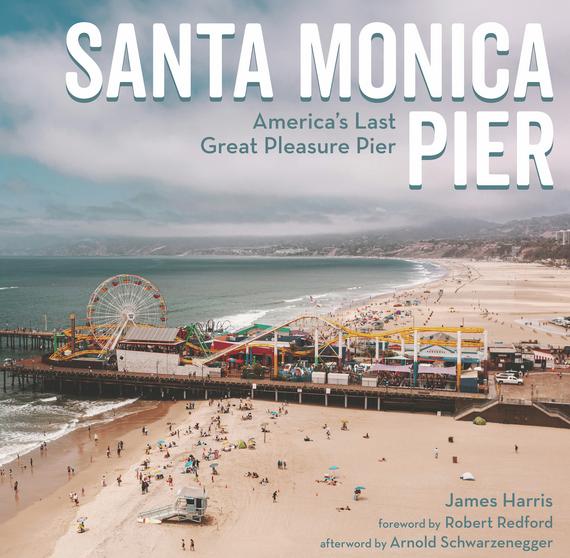
Celebrate a
century of good times on the Santa
Monica Pier! Vintage images and
magnificent color photos capture
this beloved international icon at
its very best. For a hundred
years the Pier has represented the
link between people and the
Pacific, a connection to all
that's possible, probable and
worthy of dreams. In this
commemorative collection of
vintage images, colorful artwork,
fascinating history and amazing
lore, author James Harris invites
anyone who has ever enjoyed the
Pier to revisit its past and
contemplate its future.
Its dramatic story of survival --
fighting Mother Nature, politics
and changing times -- makes Santa
Monica Pier more than a landmark,
more than a pleasure pier or a
must-see on the West Coast.
There's something for everyone on
the Santa Monica Pier. Who knew
that Popeye was born on the Pier?
That Joan Baez strummed a guitar
in an apartment above the
Carousel? Official pier historian
James Harris brings his favorite
spot in the world to life in 128
pages of pure nostalgia and
fascinating facts. If you love the
Santa Monica Pier -- and who
doesn't? -- you'll treasure this
trip back through time.
|
 |
|
|
| New edition of
Deanne Stillman's classic Twentynine
Palms |
|
|
|
Twentynine
Palms is a compelling
account of the devastating murder
of two young girls by a troubled
Marine in the rural California
desert town of Twentynine Palms.
More than just a murder-mystery,
Twenty-nine Palms is a passionate
dissection of desert life itself.
With the desert as a main
character, Deanne traces the
family histories of the murder
victims back for generations, in
one case to the Donner Party
and the other to a shack in the
Philippines, and then, the
inevitable and fatal arrival of
each family in the Mojave. The
Mojave becomes a character for
Stillman, as powerful and
immediate as any of the actors in
this real-life drama. The first
edition of Twentynine
Palms was a Los
Angeles Times bestseller,
and was named one of the best
books of 2001 by the Los
Angeles Times Book Review.
|
|
|
| Relive the Los
Angeles of Don Benito
Wilson |
|
Benjamin
Davis
Wilson
trekked
from
Santa
Fe
into
the
dusty
hamlet
of
Los
Angeles
with
Kit
Carson's
party
in
1841.
A
decade
later,
he
had
become
Don
Benito Wilson,
made his fortune and was the
second mayor of Los Angeles. His
landholdings become the sites of
Pasadena, Beverly Hills, Culver
City, Riverside and more. As a
Los Angeles County supervisor he
oversaw a Los Angeles County
that included what is today
Orange, San Bernardino and Kern
Counties. Historian Nat Read
tells the amazing story of Don
Benito Wilson,
complete with vintage photos and
illustrations.
|
 |
|
|
| Angel City Press goes
underground with Brown Acres |
|
|
In Brown
Acres: An Intimate History of
the Los Angeles Sewers, Anna Sklar
captures the complex and often
alarming history of the Los
Angeles city sewer system. With
more than fifty photographs,
diagrams and maps, Brown
Acres provides a
unique look at the underground
history of Los Angeles as it
traces the links between sewage,
ambition and politics.
|
|
|
|
|
| They
came to L.A. because it was a Paradise
Promoted |
With
more than 250 photographs and
rare ephemera, all collected by
author Tom Zimmerman,
Paradise
Promoted is the first
book to showcase the era from
1870 to 1930 when boosters
developed the small town of Los
Angeles into the city that would
become Americas most
cutting-edge metropolis. Los
Angeles was the subject of the
longest, loudest, most
persistent promotional campaign
in the history
of the United States. Nothing was
too exaggerated, absurd, or
flat-out bizarre to be fodder for
the relentless effort to convince
Americans to slam the door forever
on their home and sally forth to
what booster supreme G.W. Burton
called "The fairest daughter among
the sisterhood of cities in the
world." |

|
|
|
| A hundred years
of the Port of
Los Angeles... |
 |
The Port of Los Angeles has served its
region for a century, not just by
bringing ships and their cargo to
Southern California, but by establishing
Los Angeles as a major presence on the
international maritime scene. Because of
its Port, Los Angeles is the key that
has opened North America to the Pacific
Rim and brought the world closer
together. In 2007 the Port observed the
Centennial of the formation of the Board
of Harbor Commissioners, and the
official founding of the Port of Los
Angeles. To celebrate and commemorate
that event, Los Angeles authors Ernest
Marquez and Veronique de Turenne
collaborated to create Port of Los Angeles: An
Illustrated History from 1850 to 1945, a book devoted to
the earliest years of this remarkable
maritime center.
|
|
| See Paris Beyond
the Iconic |
The Champs-Élysées. The Eiffel
Tower. Notre Dame Cathedral. Poetic
cobbled streets, working-class
cafés, and lovers—so many
lovers. These are the classic
images of Paris, the
most-photographed city in the
world.
But now, based on an international
exhibition
curated by the authors, Beyond
the Iconic by Guy
Bennett and Béatrice Mousli
presents
a revolution in imagery—139
contemporary images from 24
photographers whose work is
preserved in the permanent
collection of the renowned
Carnavalet Museum in Paris. These
artists reinterpret the city,
capturing the day-to-day realities
of everyone's favorite capital.
Together they go deep into the
true heart of Paris. Beyond the
cliches. Indeed, Beyond
the Iconic.
|

|
|
|
|
| Santa
Monica Mountains : take a peek
(take a peak!) |
The Santa Monica
Mountains is the only range that
transverses a major metropolitan city in
North America, slicing Los Angeles and
defining it, shaping its hills and its
valleys, its canyons and its ocean
front.
The Santa Monicas is
undeniably a range on the edge of the
world, welcoming the Pacific into its
rocky ridges, almost daring the ocean
waves to break at its foothills. And these are
mountains that have gone uncelebrated,
until now in The Santa Monica Mountains:
Range on the Edge, a compelling
history and commentary by award-winning
writer Matthew Jaffe, punctuated with
140 breathtaking images captured by
renowned landscape-art photographer Tom
Gamache. |
 |
|
My
California continues to inspire
|
| We
are very pleased that the cities of Benicia,
Santa Barbara, Sacramento and Whittier have joined
Long Beach by including My California
in their Community-wide Reads events. More news is
on the California
Arts
Council website. All proceeds collected by
Angel City Press for sale of this book -- almost
$90,000 so far -- are donated to the California
Arts Council to fund writing programs in
California schools. |
|
|
|
|
| Doing swimmingly, thank you: Santa Monica Beach... |
When the land grant
Rancho Boca de Santa
Monica was
awarded to Francisco Marquez and Ysidro
Reyes in 1839, little did their families
imagine that the sand separating their
land from the waters of the Pacific
would become one of the most famous
beaches in the world, now visited by
millions of visitors each year. The
Marquez-Reyes union helped define the
history of Santa
Monica Beach. Ernest Marquez has collected
images and information that together
define the history of this magnificent
beach. Now, with dramatic
images by Carleton E. Watkins, H.F. Rile,
Valentin Wolfenstein and many more,
Marquez’s Santa Monica Beach: A
Collector’s Pictorial History
is destined to become not only the
definitive biography, but also the most
beautiful and authoritative record of an
American treasure.
Author
Ernest Marquez was born in 1924 and grew
up in Santa Monica Canyon, swimming the Pacific
waters at the heels of Olympian Buster
Crabbe and snacking on the watercress that
grew in the canyon’s creek.
|

|
|
Read / write
|
Gotta write: Please read our submission
guidelines before you pitch us your
book.
|
| "Angel City what?" |
We
are not the only "Angel City" in the City of
Angels; there are many! If you are not looking for
our wonderful books, you may be searching for
these similarly-named neighbors:
Angel City Chorale -- they
sing much better than we do...
Angel City Derby Girls --
they skate, we don't...
Angel City Brewery -- whose
products just might be more refreshing
than ours on a hot day... |
Some reasons
why we do this...
|
Our beloved brother Ron Haver loved the movies
more than anybody... |
Warrantless
search? Surrender here...
|
|
|
|